Saturday, February 26, 2011

MUSIC: Best Albums of 2010


1 - Ali & Toumani - Ali Farka Toure
No record before has ever captured the sound of death - beautiful, haunting and easily accessed, even by my ruined pop-music-loving, American ears.

2 - High Violet - The National
More about mood than it was about great song-writing, but what a mood! The National does dark better and easier more than any band save maybe Radiohead.

3 - My Beautiful Dark Twisted Fantasy - Kanye West
Overwrought, over-the-top and even downright silly at times. In a lot of ways, it's Use Your Illusion for the rap world. I haven't actually said anything good about yet: the work of a Beethoven-esque genius or Brian Wilson-esque madman, but we'll still be listening to this album in 20 years.

4 - The Lady Killer - Cee-Lo Green
Cee-lo seems to be a one man standard-bearer keeping Motown and first-wave soul alive for pop music audiences. A valuable endeavor, indeed.

5 - The Guitar Song - Jamey Johnson
I'm not going to act like an expert about country but to my ears, it has all the usual heart and expressive storytelling while really minimizing the cornpone corniness that comes with your average middle-of-the-road Nashville release.

6 - Shadows - Teenage Fanclub
Pop music, simple, pure and a delight through and through. The Fanclub still, pound for pound writes the best love song going right now.

7 - Apollo Kids - Ghostface Killah
With all the usual Wu-Tang alums making an appearance, I'm surprised the best guest turn of the year on any record was Black Thought. Ghost's best and most energetic since Fishscale

8 - Spiral Shadow - Kylesa
It's easy to miss with Dillinger Escape Plan, Future of the Left and many others, metal is in sort of a little niche golden age right now with some of the most creative releases every year coming from that milieu

9 - Swanlights - Antony & the Johnsons
A lot has been written about Antony and his ghoulish, vibrato-laden tenor. You love it or you hate it and I fall squarely in the former category.

10 - Special Moves/Burning - Mogwai
If The National does dark the best, then Mogwai does dreamy as well as anyone.


P.S. A little late, I know

Thursday, February 24, 2011

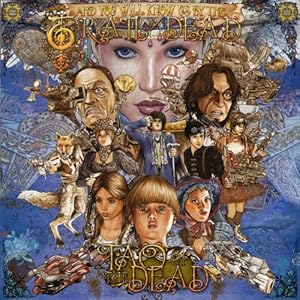
MUSIC: ...And You Will Know Us By The Trail Of Dead - Tao of the Dead

Deep, analogue bass pulse through and around your inner ear. At the same time, a half spoken/half sung monologue conjures cosmic imagery in a low whisper before the guitar crackles like an old photograph lit on fire descending into a pink nose reminiscent of the ending of "Karma Police." Before long, the noise stands aside for a bright acoustic guitar confidently strumming sunny chords before they themselves are standing aside for a blast of thick, forward-leaning distortion.


If all that sounds like an exhilarating experience, it often is and you should sprint to your local record store and pick up Tao of the Dead. And if you think that sounds like a formless, chaotic mess, well, it's that too and you and I should totally party because we think a lot alike.

Even by the ADD addled, too-many-studio-toys Pro Tools-modern standards, this is a restless album. It's progressive to be sure, but that's not especially new. That's  a direction Trail of Dead has been heading for some time. The music is joyous first and sort of pointlessly fidgety second. There seems to be little agenda from moment to moment (the demarkations of the songs themselves aren't exactly arbitrary, but they're close) other than to do something different because they did the same thing for too long consecutively.

It seems it's not enough to move to a B section with a new melody or arrangement. Why not just announce it with an unexpected blast of feedback and an enormous slow-down in tempo? Ideas are never bad in that it's always better to have too many than not enough but when you try to do everything you're not really doing anything and frankly, Trail of Dead spend a good portion of the Tao of the Dead trying to do everything with a playbook that's actually pretty limited. After the 5th sudden breakdown into crashes on every downbeat and the 4th descent into electronic pads and beeps it gets a touch wearying.

Ironically, for such a self-consciously 2011 album, the big choruses, when they do come occasionally, have a very 90s alt-nation vibe - Smashing Pumpkins with a slight Jane's Addiction flavoring. But that's part of the grandiose charm.  It IS joyous and that makes it much pleasurable an experience than it would have been had they used the same tactics to make a dark or muddy record. Tao of the Dead is never, ever muddy; it's clean in it's production. Maybe pathologically so... clinical, even, like an early Minus the Bear effort.

I'm at once having a hard time finding a kind word to say about the emo-elderstatesman's effort. but at the same time, I can't say I didn't enjoy it and maybe that's the lesson to be taken away: If you do something and don't succeed but do it enthusiastically and joyfully it will make for a pleasurable experience.

But it won't necessarily be good art.

Thursday, February 17, 2011

POLITICS: CBS News Was Guilty of Propagandizing During the Iraq War

Let's start by defining news:

CBS caresNews is the act of conveying information that has a cultural relevance and/or shared public interest.  The information conveyed in this manner, according to Dean Howard Schneider of the Stony Brook News Literacy department must be subject to some manner of journalistic vetting.

The vetting contains three sub-sections, which will be the crux of my argument going forward:  This information must be verified; it must be conveyed independently and the person or organization must be held accountable for the information they promulgate in this manner.  This is the criterion furthered by the News Literacy department at the SUNY: Stony Brook.

Furthermore, when news isn't news... that is to say, when information is conveyed in a manner that suggests news, gives the appearance of news and is in the public interest in a similar manner to news, but that news fails to meet the above criteria, then that information is propaganda.

Please watch the following video before I expand, it was produced in all likelihood in 2004:


Obviously this is news, or at least it’s meant to be news: it seeks to inform, was originally produced by professional journalists on the ground in Iraq and was aired by a well-known and often renowned news company: CBS News. However, I think it falls well short of the journalistic process and is unworthy of the CBS brand.

First, it is not properly vetted and therefore fails the “verification” requirement. I'm well aware that an argument could be made that it is easy to, with the benefit of hindsight, know that the insurgency was not “all but over” as the video claimed at the top, however, this video relies almost exclusively on unnamed “U.S. Commanders” and “Iraqi Officials,” all of whom paint the rosiest of pictures with regards to the war. The only two named in the sources in the piece are U.S. Marine Christopher Meyers and U.S. Naval Surgeon Dr. Richard Jadick, neither of whom are identified by rank, nor is whether or in what capacity their personal involvement with the anti-insurgency was,  though we can infer their roles.

How interesting that Mr. Meyers describes how RPG Gunners have “just hammer[ed] away at [the U.S.] tanks and instead of addressing the difficulties the American soldiers are facing, Ms. Palmer continues to jingoistically trumpet how hard the insurgents are being hit. Further, when Dr. Jadick says casualties were “better than we thought,” the reporter again glosses over how the expectation was “a huge amount of casualties” “in an urban environment,” especially now knowing how those huge numbers of casualties were just around the corner, it seems Ms. Palmer could have afforded to do her job and actually question whether or not things were as hunky dory as the “Iraqi officials” stated.

Secondly, this story violates the tenet of “independence.” CBS News didn’t have a vested interest in the Iraq War per se, but the reporter has a clear pro-war bias. Note how she opens the piece: the Fallujah offensive is described not as a solemn event or an unfortunate battle in the midst of a larger and serious objective but “a devastating display of American firepower.” Rambo would've blushed at that sort of "cowboy-up," gung-ho description. Moreover, the reporter uses the phrase “mop up” or “mopping up” multiple times in furtherance of the narrative that the Fallujah offensive and by extension the Iraq War is going swimmingly. Given how the reporter over-relies on unnamed sources claims that the offensive was a success and downplaying every instance of American casualties or sacrifice, I believe the piece fails the test of independence.

Finally, and in fairness, we only know this after the fact, this violates the tenet of accountability. Almost everything in this piece turned out to be factually wrong and while I know there is a provisional truth to the news that states things could have been going very well when this piece was first produced, I find it very difficult to believe that the Fallujah offensive, one of the most devastating to American soldiers in the whole Iraq War really started out this well. Given that around the time of this piece Vice President Cheney said the insurgency was in it “last throes” there was clearly a narrative being promulgated that the reporter bought into wholly. I think it’s telling that this video was put up on Youtube not by CBS News but by Maxx64, an everyday user.

CBS should be ashamed of this piece, and for all I know, they are. However, no correction, retraction or other apology has made its way from any of the major media outlets for the abdication of their journalistic responsibility to the U.S. people during the Iraq War. If they did, is was quiet enough that a voracious news consumer such as myself was able to miss it.

Everyone can be guilty of getting caught up on a nationalist fervor following an event as horrifying as 9/11, so the News Media can be forgiven for some measure of going along with the government in a show of national unity.  But this was, at the earliest, 30 full months after 9/11 and not a single one of the stated reasons for the Iraq War ever came to fruition (and before you say it, deposing Sadam Hussein was not, until much later, trumpeted as the objective of this war), the fact that our news media didn't have the temerity to start REALLY questioning this war until AFTER it had already become unpopular is a scary portend of things to come.

Let me end by saying that this was not limited to this piece or CBS News, if anyone is aware of any similar abdications on the part of the news media during the war, please send them my way.   This isn't about pro-war or anti-war, this is about baseline skepticism and journalistic practice being tossed aside at the highest level... and that's beyond unacceptable.

Monday, February 14, 2011

POLITICS: Why Google has to appear to play nice with China

For America, especially American companies, The People’s Republic of China is like wild west for modern day: a vast, untamed opportunity for companies and all Americans with an ideological missionary impulse or anyone who salivates at the largest single-state market in the world.  That’s why Google represents such an interesting fulcrum in the battle of the hearts and minds of the People’s Republic: Google is both a economic success story and an ideological entity with its motto: “Don’t be evil.”  Indeed, “that's why China hits the American mind so hard. It is a country whose scale dwarfs the United States. With 1.3 billion people, it has four times America's population. For more than a hundred years, American missionaries and businessmen dreamed of the possibilities—1 billion souls to save, 2 billion armpits to deodorize” (Zakaria 87). 

China is at once enticing as a business landscape, scary as an emerging threat to America’s hegemony and easy punching bag for its closed, police-state society.  “Easy” is an important word there because, I think, the treatment of the China’s battle with Google over internet censorship has been the jumping off point for a lot of bloviating and easy answers but no real nuanced exploration of what that system of censorship really amounts to. 

I am of the opinion that up until the point where Google directly butted heads with the PRC in early 2010, they had played their presence in the country perfectly.  Winning a short term, Pyrrhic, and most importantly, symbolic victory by rubbing China’s nose in their own censorship (something everyone is already aware of, already) is not worth the long-term effects of pulling out altogether, giving China a tacit nod to continue to become ever more insular.

It’s difficult to argue for Google not to take a constant and open stand against China’s censorship because so much more than just the interests of the Chinese government and Google are at stake:
More than a battle over territory or market share, it is a conflict over ideology, one that pits a free and open Internet that empowers individuals at the expense of existing power structures against an Internet micromanaged by those powers. "What we're talking about here is a defense of the essence of the Internet," says Jeff Jarvis, director of the interactive journalism program at the City University of New York (Moyer)
If one wants to accuse Mr. Moyer of hyperbole, many other examples of the same sentiment litter the internet following Google’s showdown with the Chinese government. “Google is defending the Internet itself against censorship, repression and attack. Finally, someone is standing up to China. When will more companies and governments follow?" (Neuarth).

Indeed, the reaction to Google’s openly confrontational showdown with the PRC early last year was hailed with almost universal acclaim from technologists and foreign policy experts alike.  “Many U.S companies that make big bucks doing business in China have put up with the censorship and tight controls imposed by a succession of communist dictators. "That makes Google all the more gutsy for spitting in China's eye this week” (Neuarth). 

Later on, experts on Google itself as a country heaped their praise on as well: “The move, if followed through, would be a highly unusual rebuke of China by one of the largest and most admired technology companies, which had for years coveted China‘s 300 million Web users... I think it‘s both the right move and a brilliant one,’ said Jonathan Zittrain, a legal scholar at Harvard‘s Berkman Center for Internet and Society” (Jacobs, Helft).

Most importantly of all, the experts pointed out, Google has the means to stand toe-to-toe with the PRC:
[A]ny large-scale circumvention effort requires a huge number of addresses to cycle through, along with an enormous amount of bandwidth to support all the tunneling. ‘If we could magically convince all Chinese people to use [these services],’ [Hal Roberts of the Berkman Center]s says, ‘then someone would have to pay for the entire outgoing bandwidth of China.’ That might strain Google's resources, but not by much. (Moyer)
Open internet advocates now see a white knight in Google where before they saw just another greedy company looking to get as big a foothold as possible in the world’s largest and most profitable emerging market.  For Google to finally reverse their decision represented a new hope for American open-information advocates: “More than any other organization, Google has both the means and the incentive to ensure that the Internet remains open. It is also one of the few organizations with a broad enough online presence to define the standard operating rules of the Internet" (Moyer quoting Rebecca MacKinnon)

Given that A) Google and the Chinese government can’t and won’t see eye-to-eye on the issue of how and when to openly promulgate information and that B) the Chinese government has a long history of taking a hard line against companies and organizations that seek to disseminate that same information, many experts see only one solution: Google should openly challenge the PRC and when that government, in all likelihood balks, then Google should refuse to do business in China.  I, however, see this as a view the lacks nuance.  Let’s look a little deeper into the situation:
“Google executives declined to discuss in detail their reasons for overturning their China strategy. But despite a costly investment, the company has a much smaller share of the search market here than it does in other major markets, commanding only about one in three searches by Chinese. The leader in searches, Baidu, is a Chinese-run company that enjoys a close relationship with the government” (Jacobs, Helft).
In another section, Jacobs states:  “Google said it would otherwise [should the PRC not allow open access to information] cease to run google.cn and would consider shutting its offices in China, where it employs some 700 people, many of them highly compensated software engineers, and has an estimated $300 million in annual revenue” (Jacobs).  I’m not trying to denigrate Google’s standing in China, $300 million annual revenue is absolutely not nothing, but it’s also not enough to hurt the PRC in any substantive way.  Google is not even the number one search engine in the People’s Republic.  I think for Google to simply pack up their ball and go home would be an act of impetuousness – one that might score some short-term brownie points with advocates at home but one likely to make little difference where it counts: in China.
              
Let’s take, by way of comparison, an American issue that has similar overtones: In 2003, the French, German and Russian government all condemned the U.S. for its intention to invade Iraq. Lacking hard, shared evidence, these governments saw U.S. action on this front as hasty.  At the time, only a very small majority of Americans supported an invasion and the vast majority of people abroad were opposed to the same.  Given all that, the French, German and Russia opposition was treated with contempt, even open hostility. 

A large part of America’s political character is pride – as such, other countries telling us what to do, even if it is not an unpopular sentiment, only makes the other side ever more recalcitrant.  Germany, France and Russia's statement was treated suspicion at best and if they moved the needle of American popular opinion at all, they moved it in the wrong direction.

China, with its long history of a similar vein self-superiority by way of Sinocentrism (indeed, China has historically referred to itself as the Middle Kingdom) has and likely will continue to respond in the same way to the intervention of foreign interlopers. 

To return the original point: if Google; an American company, seeks to change China from the outside by way of direct confrontation it is likely only to calcify the PRC’s commitment to choking off open access to information.  Open confrontation with Chinese government will satisfy critics at home but ultimately do very little by way of substantive change for the Chinese citizenry.
Observe what Google actually did, and you’ll see that they’ve deftly navigated a third way where they’ve made substantive inroads to opening up information to the Chinese without flying too much in the fact of the government:
Google, in turn, agreed to no longer provide "lawbreaking content." In effect, Google agreed to automatically stop rerouting users of Google.cn, the Chinese version of Google, to its site in Hong Kong, which was not subject to China's online censorship. Search requests now made from Google.cn take an extra click in order to visit the Hong Kong site (Red Herring Staff)
Note the bold part.  Google acquiesced to China's demand to continue censoring search results?  It only takes one click more than it did previously to reach a site on google.cn to basically have free and open access to information via Google’s search engine.  How much computer savvy is really needed to push one extra button?  Further:
The challenge for the authorities is that there is just too much to police by moderators, and automatic filters don‘t work terribly well. Chinese routinely use well-known code phrases for terms that will be censored (June 4 might become June 2+2, or May 35). Likewise, Chinese can usually get around the ―great firewall of China‖ by using widely available software, like Freegate, or by tunneling through a virtual private network (Kristof)
By Kristof’s estimates China now has: “450 million Internet users, far more than any other country, and perhaps 100 million bloggers.”  Google is throwing a lifeline to these people, who from the inside of the PRC can move the needle knowing full well that an attack on the Chinese government’s policies from an American outsider will do much less good for everyone than grassroots action from within.

In my opinion, Google played it exactly right: giving the impression of acquiescing to the PRC while really working to undermine them where it counts and spread information through backchannels that really aren’t that difficult to find.  Sure, from a purely idealistic standpoint one would prefer that Google just stand up to the bully and good would triumph over evil but Google makes their decisions in this world, not a utopian vacuum.  As such, I think it’s easy to criticize any action on the part of Google to kowtow to Chinese pressure but I believe if you look just a little bit closer, the truth is they really haven't.  In the end, I think Google equated itself nicely against its motto.  It wasn’t evil.


Jacobs, Andrew; Helft, Miguel. “Google, Citing Attack, Threatens to Exit China.” New York Times. 1/13/2010
Kristoff, Nicholas D,. “Banned in Beijing!” New York Times. 1/22/2011
Kynge, James. “China and the west: full circle.” Financial Times. 1/15/2010
Moyer, Michael. “Internet Ideology War.”  Scientific American.  00368733, Apr2010. Vol. 302, Issue 4.
Neuarth, Al. “Google is gutsy to spit in China’s eye.” USA Today. 03/26/2010
Red Herring Staff. “Google vs China.” Red Herring. 1080076X, 7/15/2010.
Zakaria, Fareed. The Post-American World. New York: W.W. Norton & Company. 2008.

Saturday, February 5, 2011

MUSIC: Mine and Cole's Wedding Playlist

A running playlist of what will be played at our wedding

Al Green - Let's Stay Together
Arthur Conley - Sweet Soul Music
Barry White - First, Last, My Everything
Beach Boys - God Only Knows
Beatles - In My Life                        
Ben E. King - Stand By Me                            (Bride and Groom's first dance)
Benny Goodman - Sing, sing, sing
Bob Marley -  Is This Love
Bruce Springsteen - Dancing in the Dark
The Clash - Magnificent Seven*
The Clash - Train in Vain
Coheed & Cambria - A Favor House Atlantic
The Cure - Close to Me
The Cure - Just Like Heaven
Cupid Shuffle
Cornelius Brothers and Sister Rose - It's Too Late to Turn Back
Daft Punk - Digital Love
The Del Vikings - Come Go With Me
Dion and the Belmonts - Runaround Sue
Donna Summer - Hot Sutff
Donna Summer - Bad Girls
Earth Wind and Fire - September
Edward Sharpe and The Magnetic Zeroes - Home
Etta James - At Last
Fitz & The Tantrums - Money Grabber
The Flamingos - I Only Have Eyes For You
Flogging Molly - Salty Dog
Four Tops - It's the Same Old Song
Frank Sinatra - The Way You Look Tonight
Frank Sinatra - The Summer Wind
Frightened Rabbit - Swim Until You Can't See Land
George Harrison - What Is Life?*
Generation X - Dancing With Myself
Glenn Miller - Moonlight Serenade
Gloria Estefan - Turn the Beat Around
Harvey Danger - Flagpole Sitta
Jackie Wilson - Higher and Higher
Jackson 5 - I Want You Back
Jackson 5 - Stop
James Taylor - How Sweet It Is                                (Cutting the Cake)
Jens Lekman - Sweet Summers Night on Hammer Hill
Jimmy Eat World - Sweetness
Lady Gaga - Just Dance
K-Ci and Jojo - All My Life
Kylie Minogue - Love at First Sight
La Bouche - Be My Lover
Lauryn Hill - Doo Wop (That Thing)
Le Tigre - Deceptacon
Louis Armstrong - What a Wonderful World (Dance with Matt's Mom)
Louis Prima - Buona Sera
Martha & The Vandellas - Heatwave
Marvelettes - Mr. Postman
Mark Morrison - Return of the Mack
Michael Jackson - Don't Stop til You Get Enough
Michael Jackson - PYT
Michael Jackson - Smooth Criminal
Mighty Mighty Bosstones - Someday I Suppose
Mighty Mighty Bosstones - The Impression That I Get
Nat King Cole - Love
Nelly - Ride Wit Me
Neon Trees - Everybody Talks
Oingo Boingo - Dead Man's Party
Otis Redding - How Strong My Love Is
Outkast - Hey Ya
The Platters - Only You
Prince - Let's Go Crazy
Queen - Don't Stop Me Now
Rancid - Fall Back Down
The Rapture - House of Jealous Lovers (The original, no remixes)
Real McCoy - Runaway
Renato Carosone - Tu Vu Fa L' Americano
The Replacements - Alex Chilton
The Roots - The Seed 2.0
Sam Cooke - Bring it on Home to me
Sam Cooke - We're Having a Party
Santa Esmerelda - You're My Everything
The Specials - Pressure Drop
Spice Girls - Say You'll Be There
Squirrel Nut Zippers - Hell
Stephanie Mills - Never Knew Love Like This Before
Stevie Wonder - Sir Duke
Stevie Wonder - Signed, Sealed Delivered
Stevie Wonder - We Can Work It Out
The Strokes - Hard to Explain
Supremes - Can't Hurry Love
The Temptations - Get Ready
The Temptations - My Girl                              (Cole's dance with her father)
Thurston Harris - Little Bitty Pretty One
Van Morrison - Jackie Wilson Said (I'm in Heaven when You Smile)
The Weepies - The World Spins Madly On
Whitney Houston - I Wanna Dance With Somebody
Ziggy Marley - Lifetime

87 songs

Wednesday, January 12, 2011

ESSAY: Law School

So, this is a little personal, but I wanted to have this on the web for my future viewing and posterity.

I am trying to get into law school. I have attended several colleges and up until last year, I fucked up my education really badly. I was given opportunities that I was too young and too arrogant to appreciate and now, I really regret the person I was and how I stupid I was for not taking advantage of them in the first place.

It's trite, but those mistakes brought me to where I am today and as painful as it is to look back on them, they were an unfortunate necessity to make my current quest have any meaning. I wish I could be one of those people who were driven by an unseen, constant force. I wish I could just be one of those people who work hard without need of constant validation for themselves as people or for the goals they're seeking. Anyway, I'm not one of those people. I do need constant validation.

I think if I make my quest to get into law school public, it might help motivate me to avoid the public embarrassment of going back against it.

Why the hell would I torture myself with law school?
So, some of you might ask, why law school?

Mort importantly, What do you want to do?

The answer is, I'm not exactly sure but I'd most like to be in public policy, and law school helps with that. Law school, as far as I can tell doesn't close any doors. If I want to be a professor, a law degree helps that. If I want to get involved in the background of politics (I do NOT want to be an actual politician), it helps with that. If I decide I want to get involved in the corporate world, it helps that. Maybe, while I'm in law school, I may decide that I actually do want to become a lawyer. Right now, though, I'm not so sure.

Let's just say it this way: for some time, I've loved the idea of becoming a history or civics professors and I can't imagine being laughed at when I apply for a job as a history teacher with a law degree. On the flip side, if I study history and try to apply for a job as a lawyer, the same could not be said. They'd definitely laugh at me.

Law school only opens doors. Yes, I know its hard. Yes I know its unbelievably expensive especially if I'm not sure that I ultimately even want to become a lawyer. Whatever. It's a good investment in the long run no matter what path I follow career-wise.

There are other factors why I want to as well:
1) Going back to school has been an enormous boon to my self-esteem. The last 18 months in school have been the only time in my adult life where I can see with absolute certainty I have been a success. I have grown to love, if not going to school itself, then the feeling of knowing what is expected of me, with constant evaluation to show if I'm doing a good job.

2) I have been a near constant disappointment to my family and I want them to be proud of me. They will be proud of me if I go to law school

3) It seems hard and I like the challenge of it but unlike the challenge of say, my band, it's an inherently winnable one. If I try my best, I WILL succeed at law school. Trying my best at my band provides no such certainties. That's not to say I don't like the challenge of my band, but it will certainly be nice to take on something that as not open-ended and near impossible to quantify victory.

4) The period of my life after I was thrown out of Loyola was the first time in my life where I felt I had no options. Until I went back to school and allowed myself to start dreaming for bigger things again, I didn't realize how downtrodden I'd become: looking forward to a life of drudgery where I don't have enough money and I can never make up for my past mistakes. Having possibilities again has given me new optimism. Suddenly I'm that same kid I was in high school: not perfect but not a total fuck up anymore, either.

I have accrued 42 credits over the past 18 months (nearly as many as whole time at Loyola) at a 4.0 GPA. For the first time in 8 years, my name has value again, I can use it to attain a better life. Anything that opens up new doors is good for my well-being, and law school opens more doors than anything I can imagine.

5) Most importantly, I owe Cole my very best attempt at a great life for her. I can't think of anything that would allow for that more than law school. If nothing else, I will go to law school because I love my fiancée.


Grades - the sad truth about my past.

"Alright, great Matt, then go to law school!"

Yeah, I wish it were that simple. I'm still not positive I can.

So here's the thing: I have 57 credits from Loyola University (nee Loyola College in MD)
From there: I have a 1.9 GPA.

Yikes, right? Yeah, I really screwed up.

Anyway, I returned to school in 2009 at Suffolk: I took 18 credits there for a 4.0 GPA.
I have since taken 24 more credits at NYIT, again for a 4.0.

"Great, Matt!" I can hear you all saying. "Surely the admissions officers will see you've done so much better since returning to school and forgive your horrid 1.9 from Loyola!"

You think so? Yeah, a lot of people have told me that same thing, and while I hope it's true, I am not planning on it. So I'm just assuming that the schools will calculate my cumulative GPA amongst all schools right now and just say that's my GPA.

So what does that mean? It means, basically, I've got a big, big hole to climb out of.

Even with 42 credits of 4.0 schooling, I've still only got about a 2.8 cumulative GPA. Applying to law school with a 2.8 will not be a fun experience, but luckily, I've got about 36 more credits to go. Assuming I get a 4.0 I will have somewhere between a 3.1 and a 3.2 when I apply to law school, which is about a B/B+ average and while that's not nearly as bad as a 1.9, it's also not very good for my law school prospects, overall.


The LSATs - my only possible saving grace

The LSATS are like the SATs for law school. They test logical reasoning, analytical ability and reading comprehension. They're scored on roughly a bell-curve, scaled from 120 - 180, with about 152 being average.

According to these slightly outdated numbers mathematically oriented majors like Physics and Economics tend to the best with a 160 average score while Criminology and Pre-law majors, ironically, tend to do the worst with a below-average 145. For what its worth, Political Science students, of which I am one, score almost exactly average with a 151.8.

In my estimation, to have any shot at getting into law school given my poor performance record, I have to get at least a 160, which would put me in the 81st percentile. And even then, I'm relying on some measure of charity from the university to which I am applying.

If I am able to get a 165 (92nd percentile), things start to get more interesting. I have to get, on average, 7 more questions right of the 101 question test if I'm to get a 165 vs. a 160.

If I get a 170 (97.5th percentile), that would mean getting 7 MORE questions right, I have some small shot at getting into some of the best schools in the country.

If by some miracle I get a 175, which would put me in the 99th percentile and I have way, WAY more options.


Don't think that much can hinge on 7-14 questions on one test? Unfortunately, (and at the same time I guess, fortunately) it does.

This website and this one aggregate admissions data from law schools and estimate your probability of getting into them based on your cumulative GPA and your LSAT scores. There is no way to measure things like your essay or interview with admissions the only other modifier is whether you are an under-represented minority (as a white, male, middle class, heterosexual New York State resident I am literally the walking, breathing embodiment of the anti-under-represented-minority)

But I digress, 3.12 GPA is just about the best I can realistically hope for without any weight being given to my later work by admissions officials given my vastly improved performance.

According to US News and World Reports rankings, the top 10 law schools in this country are:
Yale
Harvard
Stanford
Columbia
University of Chicago
New York University
UC - Berkley and the University of Pennsylvania tied for 7th
University of Michigan
University of Virginia

For those of you kids counting at home, that's 4 Ivy League schools and some of the best public schools in the history of mankind with dozens of the best known professors and alumni including hundreds of famous politicians, litigators as well as many noble laureates to their collective credit.

In other words, I won't be getting into them under any circumstance, so we'll exclude them.

Law school and LSATs, what I need to do

So, to start with, here is the bleak picture I'm faced with of the number 10 - 30 law schools if I get a 160 on my LSATs:

Photobucket

Yeah, so... not ideal. And just so you can see how high the stakes are here. This is the lower quintile of the US News and World Report's top 100 list:

Photobucket

I am not much better than a 30% shot at any school if I get a 160 on my LSATs. However, I think I can do better than that. And if I do, all of sudden the world of my future at law school looks brighter.

Here's what it looks like if I get a 165, or 7 questions better:
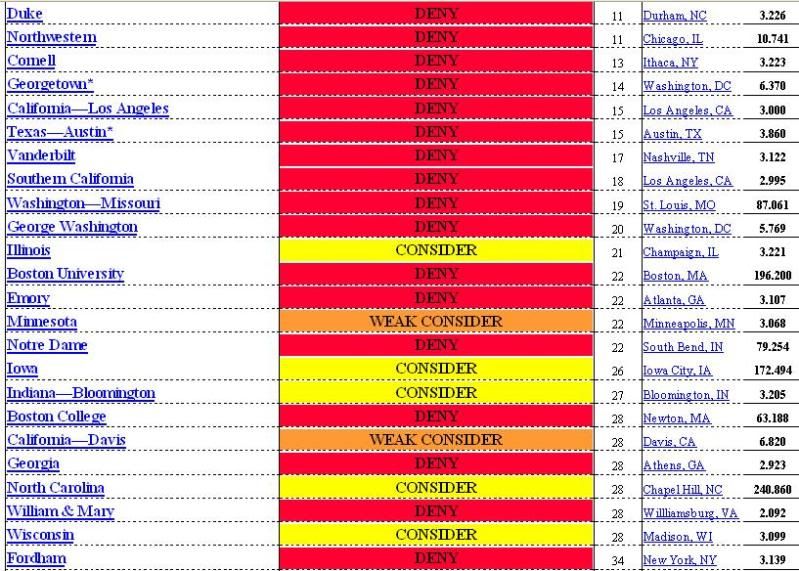
Photobucket

But look at how much better I do with those schools a little lower on the list. Remember this is just 5 points better:
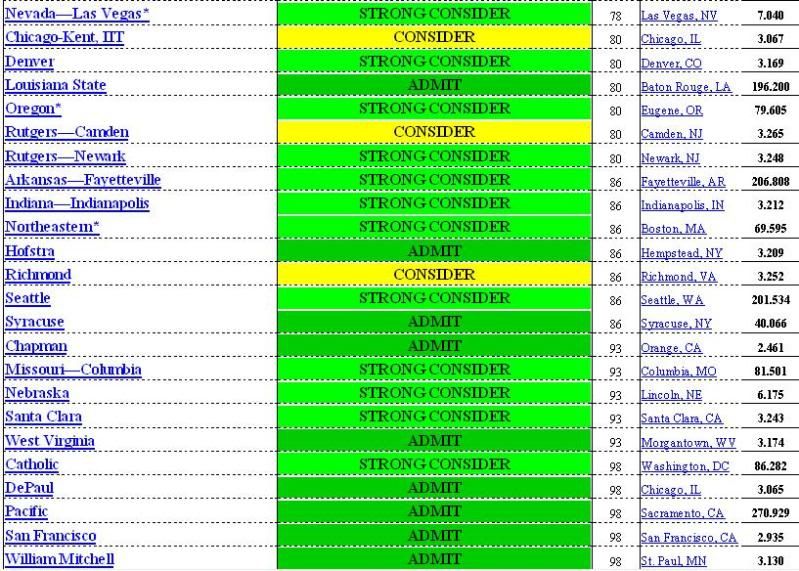
Photobucket

Look at all that green! Damn son, I might even get some money. See, this is where I start to feel really good because the first 3 practice tests I've taken I scored a 164, 166 and a 166. So basically, unless I really let my nerves take over it looks like I've got a realistic shot at schools like Syracuse, DePaul, NorthEastern, UNLV and the one most exciting to me in that group, Oregon! Hell yeah, son, I would be a duck! Anyway, I would be ecstatic to go to any of these schools.

So basically, now comes the challenging part. My REAL goal, is to get higher than a 175 on the LSATs and I will study everyday to make that a reality. LSAT scores follow you for 5 years and when they transmit your score to schools, they transmit ALL your scores. So I have to make the first time count.

Anyway, just for a "dream a little dream" moment here, this is what happens if I get a 170 with those top 30 schools:
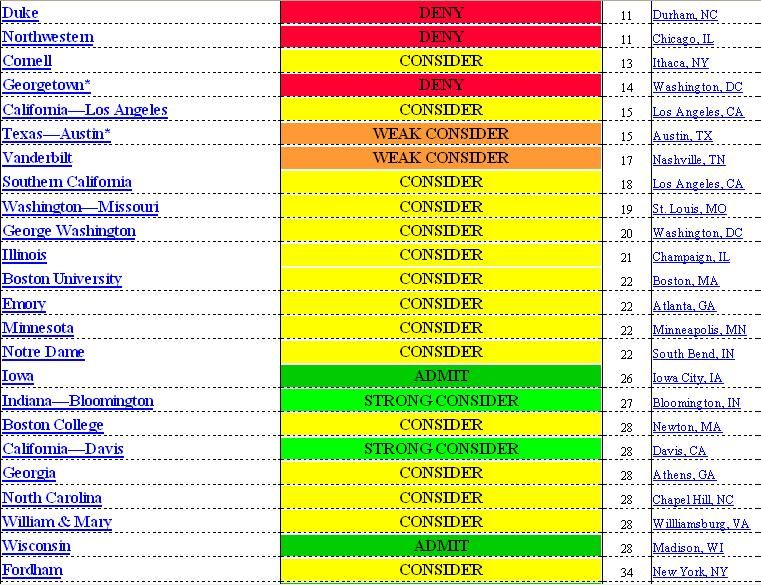

Photobucket

All of sudden, I'm not an outright rejection almost anywhere. Mort importantly, I'm getting strong consideration at places I would LOVE to go to: Indiana, Wisconsin, Davis? These are places I would LOVE to live

The last level I dare to look at, is if a miracle happens, and I get a 175:
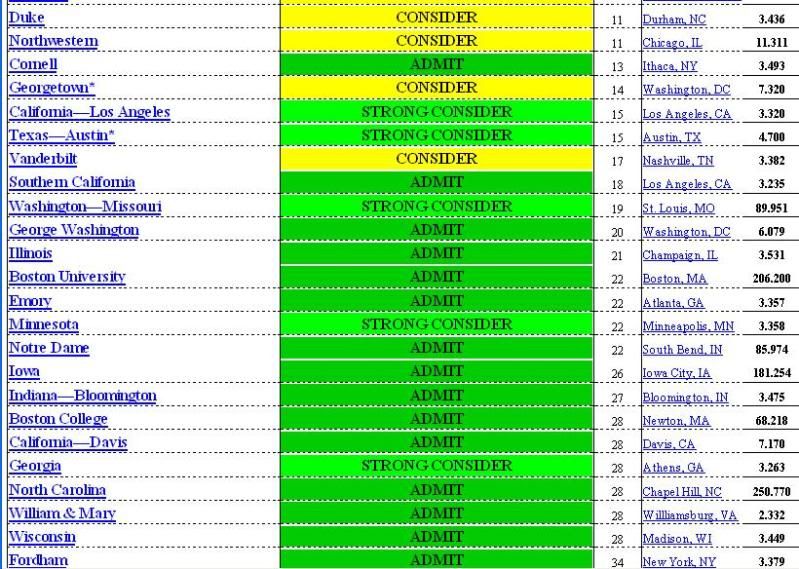
Photobucket

There's a couple real dreams schools in here: first is UNC which is near my Uncle Pat and just somewhere I've had in my head for some time that I'd like to go.

The second is the University of Illinois near my sister Jessica. Third is Notre Dame, which all Catholic school kids would love to go to.

But last, and the one that almost makes me get a little emotional is that little "admit" next to Cornell. A lot of you don't know that when I was in high school, I always talked about going to college (not unlike they way I'm doing now) and nothing ever topped, in terms of emotion and anticipation for me the weekend I went with my dad to visit Cornell. I knew getting into an Ivy League school would have made my parents happier than anything and I really wanted it too.

Cornell was something I dreamed about and talked about for years and when the time came and I was rejected, I wasn't surprised but I felt like I had given up my family's first great hope at greatness for me.

Anyway, I'm trumping it up, but the opportunity to even once again dream of the possibilty of going to a school like Cornell has got me very, very excited.

So, anyway, that's that. Get 175 and make myself into a new man. It's just that simply. Now, all I have to do is execute it.

Get on my ass, tell me to study. I'm trying to go 45-an hour every night. Hopefully I can get there.

Wish me luck and thank you so much for reading this. I know it's not interesting to anyone but me and if you've read this far, that must mean you really care about me.


Tuesday, January 4, 2011

MUSIC: What does Joe Jackson's "Look Sharp" Know About Alex Chilton?

I remember listening to an old interview of Alex Chilton that aired on the radio shortly after he passed away and more than anything else I was struck by the diffidence and blasé attitude he seemed to have about his own place in the history of pop:
“I guess in the late '70s. I spent some time in New York, and it seemed like everybody I ran into there, you know, claimed to be a fan of the Big Star albums, and that sort of stuff. And so, you know, I guess it was around then that I began to see that even though we hadn't sold any records or made any money out of the albums, that they were still some kind of success in a way, you know.”
It wasn’t quite stunning but I’d always heard Chilton spoken of in the most reverent terms; he was a man who had more credibility with indie pop hipsters than the Pope has with Catholics and he spoke of his own brilliant musical career like a dentist discussing his unsuccessful private practice at a holiday party.

The fact is, when it came down it, he lived a modest middle class life, he played golden oldies at state fairs because the money was good and the sets were short and he died in large part because he put off going to the doctor for days because he didn’t have health insurance. It’s an obvious point but it’s one that isn’t made very often: you can’t pay your damn bills with credibility.
The way the word “pop” was applied with reverence to Chilton long after the last Big Star record was released, “pop” has been used as a baton to beat Joe Jackson repeatedly about the head. To wit, you won’t find many descriptions of Jackson’s early work that doesn’t use the word in the first couple sentences and its used with some measure of distaste.

For both men, though, pop music seemed to be more a means to an end – just what you did because that’s how you made music. Jackson says in his own autobiography: “If a tree falls in the forest and no one is around does it make a sound? Or: Does music even exist, if no one's listening?” Both Jackson and Chilton seem to have a workmanlike attitude toward their own music. Sure, follow your muse, make music you can be proud of, but why even bother if no one’s going to listen? Making pop music wasn’t a conscious choice any more than it was a conscious choice to make music at all. It’s just what you do.

For his part, the line on Joe Jackson in the early days was that he married an acerbic wit with a decidedly pop aesthetic. He was too poppy for the punk-rock kids but too smart for the room; that’s the reputation anyway but I think that misses the mark pretty substantially on both accounts.
Take as a case study Jackson’s debut Look Sharp! Which has a great share of both pop craftsmanship as evidenced by the smash hit “Is She Really Going Out with Him?” and sharp wit with lines like “If you want to know about the gay politician / if you want to know how to drive a car / If you want to know about the new sex position” from the trade winds groove of “Sunday Papers.”
But the reason I say any focus on the pop aspects of or the clever wit of Look Sharp! Misses the point is because, this is an angry and if you can pardon the buzzword, edgy album and more to the point, it possesses the unsubtle obtuseness one would expect from an angry record. More often than not Look Sharp! Is not particularly incisive, nor is particularly polished.

Take for example, the little bit of rock n’ roll perfection that opens Look Sharp, “One More Time:”

“One More Time” is angular and open and incredibly fresh sounding even 30 years after the fact. It’s not that Jackson isn’t working within the pop milieu, it’s that the label is being applied in a more specific and pejorative sense. Sure, there’s a verse-chorus structure but is it really that much easier to swallow than “Radio, Radio” or “Kick Out the Jams?”

In a backwards way, I think critics like to reference Jackson’s wit almost as a way of punishing him. Eventually, he followed his muse out of rock into low-middlebrow forays into the worlds of jazz trios and classical. In the end, he was a quick-hipped dilettante with one eye toward the door and the scions of rock and new wave hated him for it. In other words, we were almost threatened by Jackson and it was easier to just toss a pithy reference to his wit or intelligence and dismiss him. He wants to leave? Fine, fuck him. Mr. Big Shot.

But again, I think this misses the point and in a strange way gives him too much credit. Take “Fools in Love” which I can only guess was received as a little too clever for the charts when it was released as a single with its mellow ska upstrokes set against an evisceration of modern love. I mean, I guess but there simply isn’t the poetry to back it up:


“Fools in love they think they’re heroes / ’cause they get to feel no pain / I say fools in love are zeros / I should know, I should know / Because this fool’s in love again.” Nothing about rhyming “zeroes” with “heroes” strikes me as interesting poetry.

The fact of the matter is the “clever diatribe” is a difficult thing to pull off without sounding affected (just ask Dennis Miller). Either Jackson was a painfully obvious lyricist with little sense of nuance, or he was, as we all were, angry in his early years and struggled, as we all did, to convey that anger in a logically cogent way.

Labels are a tricky thing, and the stickiness of “pop” when it comes to Joe Jackson is a sort of interesting exemplar of the arbitrariness behind how we raise up some men and sort of relegate others to certain purgatories. In a way, Jackson was always treated as a sort of craftsman first, as if we were being sold a bill of goods by a cynic. I don’t hear much evidence that there is any less sincere emotion to Look Sharp! than any of his peers and more importantly, Look Sharp! from a qualitative perspective stands up nicely against This Year’s Model as an artifact of the time.
Rolling Stone wrote of Jackson:
Ironically, the borderline-nasty wit and unchecked exuberance of these albums quickly gave way to self-seriousness and a middle-brow disdain of rock itself. Jackson turned into a bigger crank than his two old rivals parker and Costello put together - and that's saying a lot! The remainder of his in-print catalogue is marked by restless wandering from one musical genre to another. Sometimes the experiments works brilliantly; more often, they simply bewilder
I think the phrase “turned into” a crank is exactly the dismissal that drives me nuts. He didn’t “turn into” a crank, he started that way and while we were willing to follow Costello into whatever genre experiments he decided to cook up or alternatively, laud Alex Chilton for his steadfast worship of the pop gods, we didn’t give Joe Jackson the same room to operate. He was too pissy to satisfy our desire for pop music in easy to eat, bite-sized morsels and he didn’t condescend to us so we felt little danger of looking stupid if we ignored him.

You have to wonder if Jackson would trade his career for Chilton’s credibility. Or maybe, more importantly for us, the consumers of music, the critics and the scholars, what it says about us that we would give with one hand while slapping away with the other two different men, who followed the same exact impulse: to make music people would like, because that’s what you do. And since the reward for a lifetime of our admiration is dying too young because you can’t pay your bills, you have to wonder if anyone should really care what we think anyway.